Autoencoder-Huffman Ensemble
Two-stage compression: encoder-decoder learns a compact Latent Space Representation (LSR), Huffman squeezes it further. Published in Springer proceedings. Springer link → • Code →
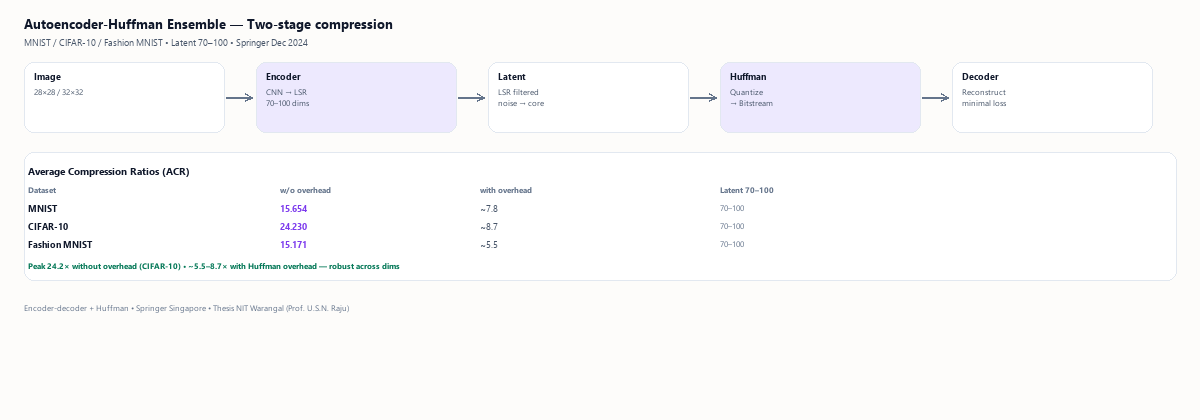
Image datasets are large and noisy. Classical Huffman is optimal for symbols but not for features; pure deep compression loses interpretability. Can a hybrid win on ratio without hurting reconstruction?
- Trained encoder-decoder to map images → low-dimensional LSR that preserves structure while filtering noise.
- Applied Huffman on quantized latent codes — classical entropy coding on learned representations.
- Evaluated across MNIST, CIFAR-10, Fashion MNIST at latent dims 70–100, with/without codebook overhead.
5.5×–24.2× compression with minimal loss.
ACRs without overhead: 15.654 (MNIST), 24.230 (CIFAR-10), 15.171 (Fashion MNIST). With overhead: ~5.5–8.7 — robust across dims. Published Springer, thesis at NIT Warangal (Prof. U.S.N. Raju).
Hybrid deep + classical beats either alone when the representation is right. Also: rigorous evaluation (with vs without overhead) matters more than a single peak number.